
| Feature | IELTS Academic | OET Medicine |
|---|---|---|
| Purpose | General academic English test accepted by many institutions worldwide | English test designed specifically for healthcare professionals |
| Accepted by GMC | Yes (must be Academic version) | Yes (Medicine version only) |
| Score Requirement (GMC) | Overall band 7.5 with 7.0 minimum in each section | B grade (350+) in all four sub-tests |
| Test Sections | Listening, Reading, Writing, Speaking | Listening, Reading, Writing, Speaking |
| Content Style | General academic topics (essays, newspaper articles, interviews) | Healthcare and medical scenarios (referrals, patient history, discharge summaries) |
| Difficulty for Doctors | Requires strong general English and ability to write academic essays | Focused on medical communication, often easier for healthcare workers |
| Test Length | ~2 hours 45 minutes | ~3 hours |
| Validity | 2 years | 2 years |
| Cost (Approx) | £180–£210 (varies by country) | £315–£340 (varies by country) |
| Global Recognition | Very high – can be used for other migration or study purposes | High for healthcare registration, but not as useful outside medical field |
| Best For | Doctors who may also want to apply for non-medical visas or study abroad | Doctors confident with medical terminology and scenarios |
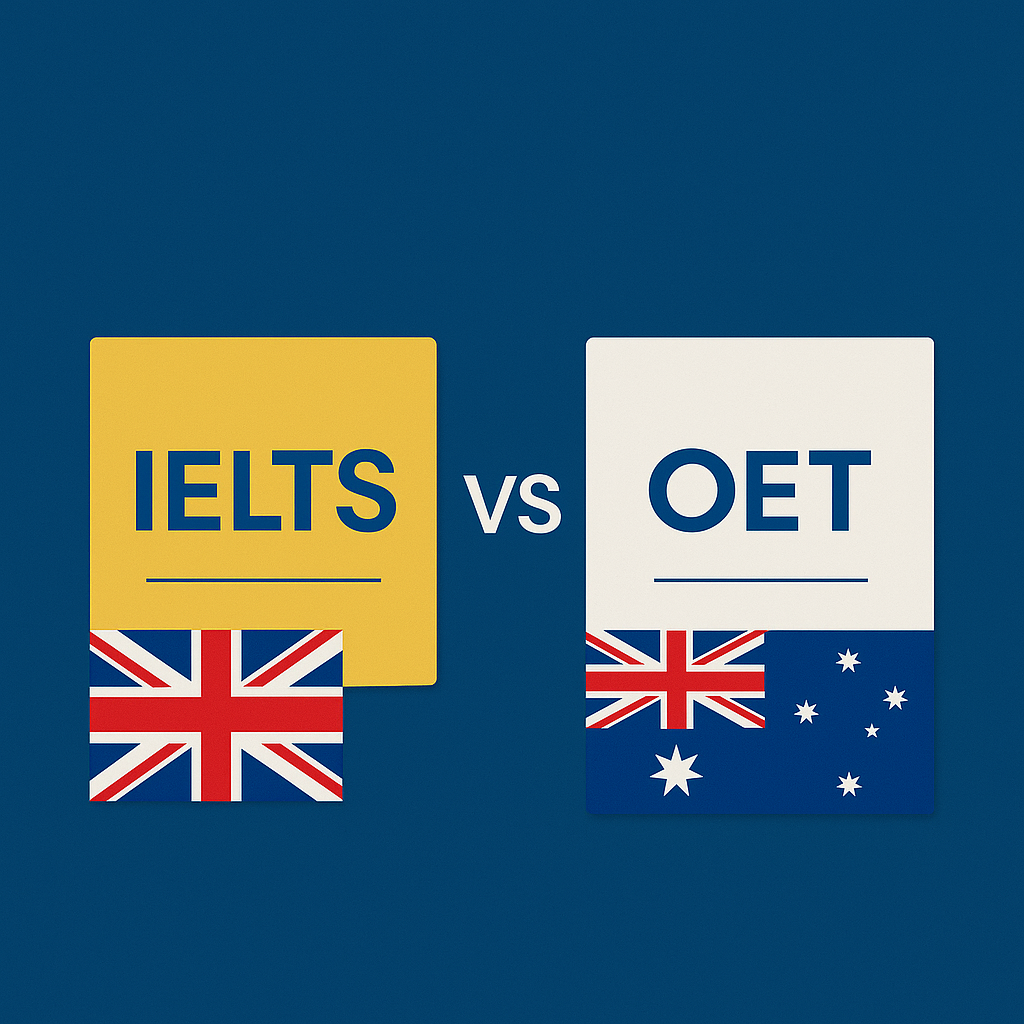
IELTS Academic vs OET Medicine
My Take as a Doctor Who’s Been There
When it comes to moving to the UK as a doctor, one of the first choices you’ll make is whether to take IELTS Academic or OET Medicine. Both are accepted by the GMC, but they feel very different in practice.
Listening
In my experience, OET Listening can be tricky at times, but not much harder than IELTS. The big difference is context. OET uses medical scenarios like handovers or consultations, while IELTS covers general topics like lectures or interviews. If you’re used to listening to patient cases or ward rounds, you’ll feel more at home with OET.
Writing
This is where OET really shines for doctors. OET Writing is much easier for most of us because it’s always in the medical field, usually a referral letter or patient discharge summary. You’re working with familiar information and language, which means many doctors score better here than in IELTS Writing, where you need to write essays on unrelated topics.
Speaking
OET Speaking is also much easier for most doctors. Instead of abstract topics or academic discussions, you role-play with an interlocutor as if you’re talking to a patient or relative. It feels natural and relevant, and you can draw on your real-life communication skills.
Cost and Availability
OET does have a downside, it’s more expensive (AUD 587, about £330) and it’s not available in as many countries as IELTS. Depending on where you live, you may need to travel to a test centre.
Future Plans
If you think you might apply for a master’s degree or PhD later, you should know that many universities require IELTS Academic, not OET. In that case, you might end up doing IELTS again even if you already have OET for your GMC registration.
Overall Consensus
The general consensus among doctors is that OET is easier to pass, especially if English isn’t your first language but you’re confident in medical communication. It feels more relevant, less intimidating, and more in tune with our daily work.
My advice: If your only goal right now is GMC registration, OET is often the smoother path. But if you want maximum flexibility for future academic opportunities, IELTS might be the smarter choice.
From my personal experience, the best place to familiarise yourself with the Occupational English Test is the official website: https://oet.com/. If your base English is already at a solid B2 level, you usually don’t need to practise excessively. I recommend getting a few sample tests and trying them—if you score around 31–32 out of 42 in each skill, you can probably aim to sit the exam within the next 1–2 months. However, if your scores are lower, it’s better to work on improving your core English skills first before returning to OET preparation, as there aren’t as many comprehensive preparation resources available for OET compared to other exams. This approach has worked well for me personally.





Leave a Reply