
Understanding the PBS, Authority Prescriptions, and Real Clinical Scenarios
Prescribing in Australia is closely tied to a national system called the Pharmaceutical Benefits Scheme, commonly referred to as the PBS. For doctors trained overseas, this system can initially feel restrictive or confusing. In reality, it is designed to ensure that medicines are used safely, appropriately, and affordably, while still allowing clinical judgement when required. Learning how to prescribe correctly in Australia is less about memorising drug names and more about understanding how to navigate the PBS framework.
What the PBS Is and Why It Exists
The Pharmaceutical Benefits Scheme is an Australian Government program that subsidises prescription medicines for eligible patients. When a medication is listed on the PBS, the patient pays a fixed co-payment and the government covers the remainder of the cost. This is why many medicines that are extremely expensive in other countries can be accessed affordably in Australia.
From a prescriber’s perspective, the PBS introduces rules around who can receive a medicine, for what indication, and under what conditions. These rules exist because some medicines are costly, some carry significant risks, and others should only be used after simpler treatments have failed. The PBS is therefore both a funding system and a clinical governance system.
Writing a Prescription in Australia
An Australian prescription must be complete, legible, and compliant with legal requirements. It must clearly identify the patient, the medication, and the prescriber. In practice, most prescriptions are generated electronically, but the legal requirements are the same whether the prescription is handwritten or electronic.
When prescribing under PBS, the doctor is not simply choosing a medication. They are also declaring that the patient meets the PBS criteria for subsidised supply. If those criteria are not met, the prescription must be written as a private prescription, even if the medicine itself is commonly PBS listed.
How to Navigate the PBS Website Properly
The PBS website is the single most important prescribing tool in Australia. Every doctor should feel comfortable using it daily. The site allows you to search for a medicine using its generic name and then view the exact conditions under which it is subsidised.
When you open a medicine on the PBS website, the most important section is the restriction information. This section tells you whether the medicine is unrestricted, restricted, or authority required, and it explains the clinical criteria in plain language. These restrictions are not suggestions. They are the legal basis on which the medicine can be subsidised.
Unrestricted and Restricted PBS Medicines
Some medicines on the PBS are listed as unrestricted benefits. This means they can be prescribed for any indication without needing approval. Common examples include paracetamol and many standard antibiotics. In these cases, prescribing is straightforward and does not involve additional PBS steps.
Other medicines are listed as restricted benefits. This means the medicine is subsidised only for specific indications, but no authority approval is required. The responsibility lies with the prescriber to ensure that the patient fits the restriction.
Authority Required Medicines and Why They Matter
Authority required medicines are those that need explicit PBS approval before they can be dispensed as a subsidised prescription. These medicines are often expensive, have strict clinical indications, or require specialist oversight. Authority approval confirms that the patient meets PBS criteria and protects both the prescriber and the health system.
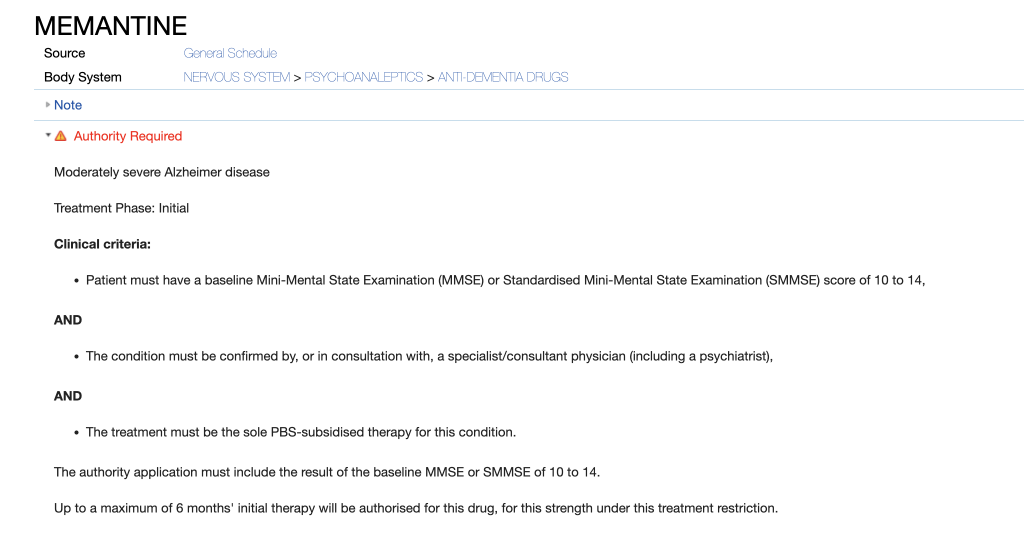
A common real-world example is Memantine for Alzheimers.
Calling PBS for Authority Approval
When a medicine requires authority approval, the prescriber contacts the PBS Authority line. This process is routine and expected in Australian practice. The call involves confirming the patient’s details, the medication, and the clinical indication. The operator follows a scripted checklist based directly on PBS criteria. If the criteria are met, an authority approval number is issued.
This number is not optional. Without it, the pharmacy cannot dispense the medicine as a PBS prescription. Authority calls are not a sign of uncertainty or inexperience. They are part of safe prescribing in Australia.
Authority Required (Streamlined) Prescriptions
Some authority required medicines do not require a phone call. These are known as streamlined authority prescriptions. In these cases, PBS has pre-approved common clinical scenarios and assigned them a numerical code. By writing this code on the prescription, the doctor is confirming that the patient meets the criteria.
Direct oral anticoagulants are a classic example. Apixaban, for instance, is PBS subsidised for non-valvular atrial fibrillation when stroke risk factors are present. Each indication has its own streamlined code. The prescriber must still confirm eligibility, but instead of calling PBS, they simply include the correct code on the prescription.
This system is efficient, but it also carries responsibility. Using an incorrect code or prescribing outside criteria can result in the prescription being rejected or audited.

Common Errors and How to Avoid Them
Many prescribing issues arise not from lack of knowledge, but from lack of PBS awareness. Prescriptions are commonly delayed because an authority number is missing, the wrong streamlined code is used, or the PBS quantity is exceeded. Pharmacists are accustomed to identifying these issues and will often contact the prescriber, but this can delay patient care.
The safest approach is to assume that any unfamiliar or expensive medication requires PBS checking. With experience, this process becomes second nature.
Final Thoughts
Prescribing in Australia is a skill that combines clinical judgement with system knowledge. The PBS is not an obstacle. It is a framework that supports safe, evidence-based, and affordable care. Once you understand how to navigate the PBS website, how authority prescriptions work, and how streamlined approvals are used in real clinical settings, prescribing becomes straightforward and confident.





Leave a Reply